NH Species List & photos
Mission statement
NH Species Display Exihibitions
Tips for touring this site
Specimen example selection
Notes on mineral identification
Site content
Systematic species collecting
NH mineral collecting
Printable NH species checklist (pdf)
Articles on NH collecting
Acknowledgements
NH unknowns gallery (coming!)
Literature references (pdf)
NH Mineral Clubs
Tom Mortimer biography
Contact me
|
Site Mission Statement
This site is dedicated to the documentation and confirmation of New Hampshire
mineral species. Many states, particularly New England states, have
mineral species lists that have evolved over the years. Typically these are an alphabetical listing of
mineral species to be found within the borders of the state. Frequent updates to these lists
have been necessary as the science of mineralogy has developed. New species names have been added,
others renamed or deleted. The lists on this site contains 335 New Hampshire species, (including 41 species Added after 2010 documented in a separate gallery). Ideally, state mineral
lists conform to the currently approved species definitions. Many minerals have names that are not recognized as species names, (eg. mica, tourmaline).
A Reference list
is provided to assist with associating these names with approved species names.This site was developed in conjunction with a
display of New Hampshire mineral species, presently on loan to the McAuliffe-Shepard Discovery Center, Concord, NH. The display was designed to be permanent and self
contained, with size and weight such that it could be easily transported, (see design criteria). This display may be
electronically coupled to a local copy of these web pages, so that as each specimen is viewed on a web page, the
physical specimen is illuminated in the display.
What's New Corrections and analytic updates to existing photos are noted on my
log page .
03-22-24, Added New gallery photos #188.
03-19-24, Added New gallery photos #187.
03-02-24, Added New gallery photos #186.
02-15-24, Added New gallery photos #185.
12-28-23, Added New Articles . Many new articles on NH localities, species, and shows.
12-22-23, Added New gallery photos #184.
12-14-23, Added New gallery photos #183. More contributions by Bob Wilken
12-12-23, Added pdf copies of two dozen articles that I have written over past fifteen years..
12-10-23, Added New gallery photos #182. Contributions by Bob Wilken
12-05-23, Added Location and photos of many old Amherst granite quarries.
11-27-23, Added New gallery photos #181.
11-21-23, Added New gallery photos #180. Fletcher Mine specimens from the Doug Rambo collection
11-10-23, Added Fletcher Mine, Groton, NH gallery.
10-23-23, Added New gallery photos #179.
10-18-23, Hurricane 'hematite' tablets analyzed to be ilmenite. Ellacoya phlogopite analyzed to be annite.
See (site history)
for a log of this site development. (back to top)
NH Species Display Exihibitions
04-01-15, The NH mineral species display was on exhibit at the GSA Northeastern Section Meeting, Bretton Woods, NH
(2015 GSA display photo).
05-26->28-13, The NH mineral species display was on exhibit at the PEG 2013 Conference, Bartlett, NH
(PEG 2013 display photo).
04-30-13, The NH mineral species display is on extended exhibit at the McAuliffe-Shepard Discovery Center, Concord, NH
(MSDC display photo).
03-17->20-13, The NH mineral species display was on exhibit at the GSA Northeastern Section Meeting, Bretton Woods, NH
(2013 GSA display photo).
02-01-13, The NH mineral species display is on exhibit at the Amherst, NH, town library for two weeks.
(Amherst Library display photo). A new touch-screen monitor
has been incorporated into the exhibit.
10-19->31-12, The NH mineral species display is on exhibit in the NH Department of Environmental Services lobby, Hazen Drive, Concord, NH
(2012 DES display photo).
08-25,26-12, The NH mineral species display was exhibited at the 2012 Capital Mineral Club show, Concord, NH
(2012 CMC display photo) .
04-19->22-12, The NH mineral species display was exhibited at the 2012 Rochester Mineralogical Symposium
(2012 symposium display photo) .
08-04-11, The New Hampshire mineral species display was exhibited
at the Gilsum Rock Swap, June 25, 2011, Gilsum, NH.
(Gilsum display photo)
05-15-10, This New Hampshire mineral species display project was a feature talk
at the Micromounters of New England Symposium, Auburn, MA.
08-29,30-09 The New Hampshire mineral species display was exhibited
at the Capital Mineral Club show, Everett Arena, Concord, NH.
(CMC display photo)
05-03-09, A presentation was given on my NH species display at the Rochester Mineralogical Symposium,
RMS Abstract
with the display exhibition, (RMS display photo)
(back to top)
Tips for touring this site
The species photo pages are best viewed with a display resolution of at least 1152 x 864. This resolution
allows each entire species page to be viewed without need for the right scroll bar. For most Windows browsers,
the "F11" key eliminates the screen top tool bars, resulting in a less cluttered viewing experience,
(toggling the F11 key again restores the tool bars.)
The "Next" and "Previous" links on the right side of each species page allow easy navagation through the alphabetically
ordered New Hampshire species. The "species data" link provides additional information on the photoed specimen,
including identification method, literature references, and EDS plots when available. The "mindat.org" link connects
to the mindat data page for the current species. Most mineral species pages also have a link to a gallery of specimen photos
from other New Hampshire localities.
(back to top)
Specimen example Selection
Coordination of this site with a fixed size physical display places constraints on specimen
example selection for the "top page" mineral photograph, (which coincides with the display case specimen). Many NH mineral species occur in samples
of only a few millimeters or less. Magnification is required to observe and appreciate them. Modern
digital micro-photography provides a means to easily share micro-minerals with a large audience.
At the other size extreme, numerous New Hampshire species have
been found in excellent large specimens. However, the size and weight limits of my physical
display has limited the "top page" photo selection to specimens that are "thumbnail" size and
smaller. Most species have an associated photo gallery where the range of New Hampshire examples for each species may be explored.
A dimensional Range scale photo is
provided as an aid to understanding the extremes of specimen sizes in the photographs. For many of the NH species, the
photos on this site are the first web publication of New Hampshire examples of these minerals.
Some species reported from New Hampshire have only been identified in sub-microscopic, embedded, grains in thin section samples.
These minerals are not included on this web site. (back to top)
Notes on Mineral Identification
Mineral species identification is based on chemistry, crystallography, and optics. Mineral chemistry
is the resolution of which elements are present in a sample and in what proportion. There are several modern
methods that can be used to determine the elemental content of a mineral. The most common method is Energy
Dispersive Spectrometry (EDS). This technique examines the X-Ray energy spectrum emitted from a sample that
is targeted by an intense electron beam. EDS analysis may be qualitative, semi-quantitative, or quantitative.
Qualitative or semi- quantitative EDS analysis will reveal which elements are present and give some indication
of their relative proportions. Some of the mindatnh data is from qualitative EDS analysis. Knowing the approximate chemistry of
a sample usually narrows the species definition to a few choices. A complete solution to the mineral ID puzzle
is aided with knowledge of the specimen crystal morphology, luster, hardness, specific gravity, solubility,
mineral environment, and associations.
In many cases the EDS plots on this site did not originate from the specimen in the photo/display, but from
another specimen from the author's collection. In some instances the EDS plot came from a similar specimen of
the same locality from a fellow collector.
It is appropriate to note that many members of the phosphate mineral group and the amphibole mineral group
(both abundantly represented in New Hampshire) are very difficult to conclusively identify by chemistry alone.
X-Ray Diffraction (XRD) analysis is often employed for a final determination of species within these
mineral groups.
Frequently, the identification of mineral species represented on this site is based on the analytical work of
others. Mineral species lists have been documented for many New Hampshire mines and mineral localities. Much
of this research has been recorded in journals and USGS monographs. Mindatnh identification of specific species
at specific NH localities relies heavily on this preceding work. To the author's knowledge, this mindatnh.org web
site is the first to report the New Hampshire occurrence of the following mineral species: beaudantite, calciotantite,
dickite, ferrosilite, greenockite, halotrichite, jarosite, marialite, romanechite, and wodginite.
(back to top)
Site Content
The majority of the specimens and photographs on this site are from the collection of
Tom Mortimer. A few species marked with a "**" link on the species list page are from other collections.
Some gallery photos provided by friends have a blue or pink lower caption.
Use of photos and text from this site is permitted within the constraints of the here-by granted Creative Commons license, CC BY-NC.
Consult limitation allowance here. In most cases high resoultion images can be provided.
A statewide species list is certainly open to challenge. A number of mineral species that
were present on some earlier NH species lists have been eliminated from my list. Resolving these questionable species
is an ongoing effort. Input from the collector community is solicited.
The Palermo Mine in north Groton, New Hampshire has the largest
species list of any locality in the state. I have relied on Bob Whitmore's book, The Pegmatite
Mines Known as Palermo as an authoritative reference on which species are to be found
at Palermo. (Several species have been added to the Palermo list since the book was published in 2004.)
A prime purpose of this site is to provide a voucher
confirmation of mineral species to be found within the state of New Hampshire. Additional information
on the physical, chemical, and optical properties of the minerals included on this site can be found
via the mindat.org link provided on each web species page.
(back to top)
Systematic Mineral Species Collecting
A systematic mineral species collector will acquire specimens other collectors reject. Not all species
in the mineral kingdom occur in beautiful, well-formed, colorful, samples. This is particularly true if
one limits a collection to a small geographic region. The definition of a mineral,"a naturally
occurring, inorganic, crystalline solid, with definite chemical composition and physical properties,
" does not include the terms "beautiful" or "colorful."
Many of the unattractive mineral species in New Hampshire are overlooked, or simply not recognized, by
mineral field collectors. Some of these overlooked species are actually quite common and readily
obtainable. It is hoped that this site will aid collectors in recognizing some of these minerals.
In addition to collecting the "ugly," a species collector must also collect the very small.
By "very small" it is meant a millimeter in size, or less. Knowledge of the mineral collecting
environment, (e.g. pegmatite, ore vein, skarn), is critical to finding and identifying micro-minerals.
Micro-mineral field samples are typically collected by the "bucket-full." These are brought
home and carefully examined under the microscope. New England micro-mineral collectors can have the
pleasure of field collecting in their homes throughout the long cold winter months!
(back to top)
New Hampshire -- a great state to collect minerals
New Hampshire is an excellent location for the amateur mineral field collector. In addition to the world
renown Palermo Mine, New Hampshire is blessed with hundreds of other lesser known pegmatites, many rich
with extensive suites of primary and secondary phosphate and lithium mineral species. (See
NH pegmatite districts.)The Conway
Granites of the White Mountain pluton are host to miarolitic cavities that have yielded outstanding
smoky quartz, topaz, and microcline specimens. Numerous metamorphic and contact metamorphic regions have
rewarded NH collectors with world class specimens of staurolite, garnet, epidote, and cordierite.
Sulfide ore veins? We have those as well. The Mascot Mine in Gorham, the lead mine in Madison, Ore Hill
in Warren, and Mineral Hill in Wakefield have provided a great suite of colorful, well crystallized,
(but micro), minerals. Gold panning? We have that! Intensely colored fluorite veins? Visit Westmoreland!
And to round the environment group, we have a small skarn deposit in Amherst that provides a nice
calc-silicate suite of grossular, vesuvianite, scapolite, and diopside.
(back to top)
Acknowledgements (Memoriam links included)
My success in assembling an extensive collection of New Hampshire mineral species specimens has been
greatly aided by the generosity of many friends. I have acknowledged the source of each specimen
on the respective photo page. My sincere thanks to:
John Anderson, Gene Bearss, Steve Cares,
Janet Cares,
Peter Cristofono, Fred Davis, Don Dallaire, Carl Francis, Gordon Jackson, Bob Janules, John Jaszczak,
Inge & Dana Jewell, Curt LaPlante, Jim Nizamoff, Ray Meyers, Jim Parella,
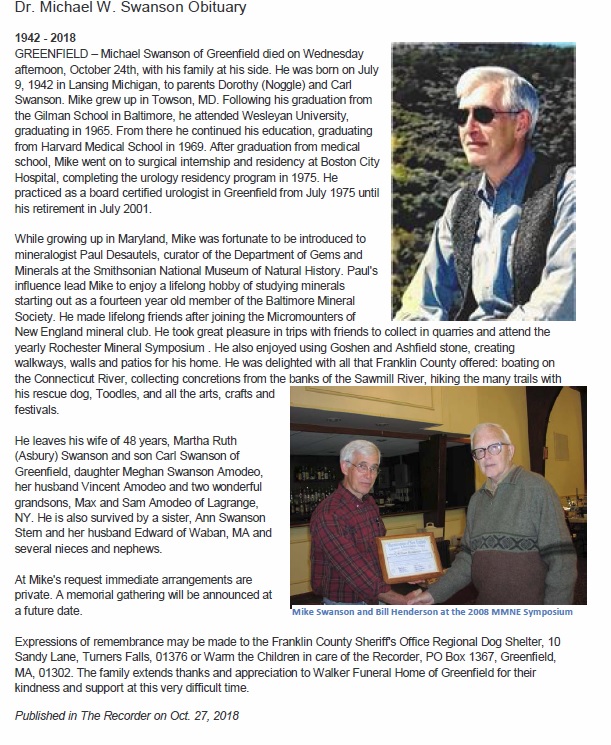
Mike Swanson, Don Swenson, Mike Undercofler,
Vince Valade, Bob & Anna Wilken, Bob Whitmore, Scott Whittemore, Paul Young.
(back to top)
Biography - Tom Mortimer
I have been actively field collecting New England minerals for the past 48 years. An early childhood visit to Mt. Mica
in Maine was my first exposure to mineral collecting. I have been hooked ever since. I am purely an amateur collector,
I have no formal training in mineralogy or geology, (I am a retired electrical engineer). I was an active member
of the Nashua Mineral Society from 1974 until its disbandment in 2010, and the Micromounters of New England since 1984. I have learned a great deal
through my association with these clubs. My other interests include hobbyist electronics and woodworking. All my hobby
interests have converged on my New Hampshire Mineral Species Display project and on building this mindatnh.org web site.
In 2015 I began Energy Dispursive Spectroscopy (EDS) mineral analysis utilizing the Boston College instrument. Since the
start of this activity, co-analyst Peter Cristofono and I have analyzed over 1200 samples of minerals from New England
specimens submitted by members of the Micromounters of New England club.
I was honored with induction into the Micromounters Hall of Fame in October, 2022, (photo) .
(back to top)
Contact me- Tom Mortimer
Please forward your comments on this site to: tom@mindatnh.org.
I am particularly interested in errors, omissions, and updates related
to the New Hampshire mineral species list. (back to top)

|